X 0 1 2 3 4 5 6 7 8

Section Five
Singularities
23. Poincare Sections
Chemistry
X 0 1 2 3 4 5 6 7 8 |
|
Section Five |
| Singularities |
| ___ |
| 23. Poincare Sections |
| 24. Linear Algebra |
| 25. Optimal Controls |
| 26. Potential Theory |
| 27. Envelope Curve |
| 28. Vibrations |
| 29. Time |
| 30. Uncertainty |
| 31. Quantum Chemistry |
| 32. Fractal Theory |
TAB 26
POTENTIAL THEORYIt is possible to represent gravity as a potential

This means that gravity is an irrotational field (conservative) and

Which means that gravity is incapable of two of the phenomena commonly associated with it, the centrifugal and coriolis forces because they are both rotational forces.
On the other hand, electromagnetic theory states that an  field is irrotational

if is due to static charge. While  and
and
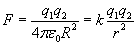
which is exactly as the universal law of gravity. So, is analogous to  but since it is well know that is not irrotational; then that means the associated with force from static charges per the inverse squared law for electrostatic force comes from charges that are not really static at all, at least on the quantum level. The corollary in gravitational terms is that the mass in gas giant planets is not static or uniformly distributed, but arranged perhaps in the kind of core and anomaly masses posed earlier.