X 0 1 2 3 4 5 6 7 8

Section One
N-1 Body Problem
1. Small Ellipses
X 0 1 2 3 4 5 6 7 8 |
|
Section One |
| N-1 Body Problem |
| ___ |
| 1. Small Ellipses |
| 2. Symmetric Plane |
| 3. System Wave |
| 4. Binary 4BP |
| 5. Barycenter |
| 6. Interference |
TAB 2 THE SYMMETRIC HYPERPLANEABSTRACT
ABSTRACT
The purpose of this study is to find a plane about which the motion of all the planets is symmetrical. The method used to reach this result takes the form of an inverse problem; e.g. the study of a body of seemingly random data, trying to create a theory to explain it. This is basically what Kepler did; but now a different, perhaps more elaborate, solution is sought. A compelling geometric basis of this symmetric plane is to see that it is formed by a straight line fixed at either end to a point on two rotating circles, one centered at the Sun and the other centered at say Jupiter. This line, while making a complete revolution around the Sun (each circle, meanwhile, making one rotation), traces out the symmetric plane. The resulting shape has the Relativistic space-time distortion at the Sun; and a kind of vortex at the outer pivot point. This paper makes no pretense that the symmetric hyperplane derived has some theoretical basis, other than to provide sufficient facts to justify not disregarding it all together - holding out hope that the elegance of the fit might prove fruitful in using this as a coordinate transformation scheme.
A Geometric Study
A powerful technique, frequently applied in Celestial Mechanics to gain insights into an otherwise intractable problem, is to transfer coordinates to another frame of reference. What is sought here is to find a three dimensional plane in space about which the motion of all the planets in our Solar System is perfectly symmetric.
Consider the orbital positions of the planets, reduced to a manageable set of data. The method in concept is as follows:
(3) This is repeated at 10° increments through 360° of longitude
The slope of the 36 lines thus created varies sinusoidally, which thus defines a flat XY plane in 3D space.
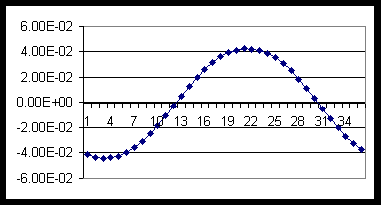
Slope vs. Heliocentric Longitude
The intercept of the 36 lines varies sinusoidally. This creates a distortion at the origin; i.e. in the vicinity of the Sun.

Intercept vs. Heliocentric Longitude
The true measure of this new plane in space is how symmetric the motion of the planets is with respect to it. This motion is shown in the topmost graph to be uniformly sinusoidal in the z-direction.

Position Perpendicular to the Symmetric Hyperplane
Observe that all planets (excepting Venus, and Pluto) are sinusoids exactly in phase, with the same leading phase angle. Venus and Pluto are exactly pi radians out of phase with the other planets; they also exhibit retrograde rotation, so being out of phase with the other planets in prograde rotation is a logical consequence. (The graphs of the planets are arranged in their actual sequence but adjacent to each other, disregarding the large gaps between each orbit.) The curve for each planet is not a closed curve because of the action at the origin of this new coordinate plane, which is not fixed at barycenter, which results in one cycle of a sinusoid, whereas a coordinate system fixed at barycenter would generate an elliptical shaped pattern versus the symmetric plane.
The important thing is that the motion of each planet is symmetric with respect to this plane. In the course of a revolution around the Sun, each planet actually traces out an ellipse in an inertial coordinate system. The geometry of the ellipse determines the inclination and eccentricity of the orbit, and the orientation of the ellipse determines the longitude of the ascending node. In a manner of speaking, there is two body motion in a local coordinate system rotating with each individual planet.
Upon closer inspection, the symmetric plane derived here is not the sort of static plane that is usually associated with the word – that is, it is not completely flat in 3D space. There is a relativistic distortion of space at the origin.
The symmetric plane is not so easy to conceptualize, but consider a straight line affixed in sliding contacts to two circles: a small one with center at the Sun and a larger one with center in the vicinity of Jupiter's orbit, near to the transition between the small inner planets and the much, much larger outer planets. This line, rotating through 360º in 3D space forms the symmetric plane; both circles also rotating through 360º as the mechanical system makes one revolution around the Sun.
The Fortran source code used to generate the data used in this analysis is at the end of this paper.

Earth and its Orbit around the Sun
Analysis
Matrices allow points and vectors to be rotated in space about coordinate axes, translated in space, and referenced relative to other reference frames. The above describes a transformation to a plane at some angle to the ecliptic, and this transformation can be done by a matrix once the plane itself is found. This allows us to look at the motion of the planets in a rotating coordinate system fixed upon any given planet. The transformation is linear and its eigenvectors are presumably the principal axes and the eigenvalues are perhaps the relative strength of these axes.

Planetary Motion versus the Symmetric Plane
Getting a little ahead of the game, consider the possibility that 3D space in the region of a star is built just like the system wave (3), then the approximation to the ellipse in (1) is exact with just one term, and for all ellipses - not just those with small eccentricity. This greatly simplifies all calculations if they are performed in this hyperspace construct.
The following figure shows some geometry of this hyper plane.

The system wave theory (3) is based on the premise that the electromagnetic nature of Earth (and the other planets) acts to align the planet's axis of rotation so that it always points to the same point in the celestial sphere. The planet's equator is always aligned along the curved s-shaped fragments (which are not to scale, and the symmetric plane is skewed to the celestial equator - these two properties are elaborated in the next paper), shown all together in the above illustration.
Individually, each planet's sine wave fragment is traced out two times in the course of an orbit around the sun, following the same path forward and backward. Plotting this same path versus the symmetric plane with the origin fixed at the sun (without the y-intercept varying) results in a closed figure-8 loop. In this regard, each planet is in a stable orbit versus an equilibrium point. These equilibrium points are strange or chaotic attractors (14), mathematically. Celestial mechanics considers them halo orbits around stability points, in the rotating coordinate system (taking out the bias in the x-coordinate generates an ellipse versus the symmetric plane).
You will notice that the computer algorithm is itself an approximation, used to find the heliocentric coordinates in an "inverse problem" type of discovery here. It uses a simple sine variation about the semi major axis (the first term approximation for the small eccentricity ellipse (1) model), which gives the kind of Keplerian approximation of planetary positions accurate to what an amateur astronomer might be able to achieve. This paper seeks to solve Kepler's problem with a slightly more accurate set of data, and (1) shows these data to be accurate to four to six significant digits, which is to the accuracy of the data input.
C
C The Inverse Problem of Celestial Mechanics
C by WH Clark
C
PROGRAM SEROS
implicit REAL*8 (a-h,o-z)
REAL*8 Elemts(5,9),Hx(40),Celestex(10,40),Celestey(10,40), LSfit(40,2),Bary(10,40) OPEN (6,FILE='a.out')
1 FORMAT (1X,2E8.4)
pi = DACOS(-1.D0)
C
C Read orbital elements into an array for the nine planets; source:
C Celestial Basic: Astronomy On Your Computer
C by Eric Burgess, Fellow Royal Astronomical Society
C (1960 Epoch) published by Sybex
C
DATA Elemts / 0.387100,0.079740,2.735140,0.122173,0.836103,
+ 0.723300,0.005060,3.850170,0.593410,1.331680,
+ 1.000000,0.017000,3.339290,0.000000,0.000000,
+ 1.523700,0.141704,1.046560,0.031420,0.858702,
+ 5.202800,0.249374,1.761880,0.019720,1.745330,
+ 9.538500,0.534156,3.125700,0.043633,1.977458,
+ 19.182000,0.901554,4.490840,0.013960,1.288050,
+ 30.060000,0.270540,2.334980,0.031416,2.291620,
+ 39.440000,9.860000,5.231140,3.001970,1.918120 /
C
C Read data into heliocetric longitude array in 10 degree increments
C where Hx(1) = 0 degrees; Hx(35) = 350 degrees
C (calculation units are in radians)
C
Hstep = 0.D0
DO 10 n=1,36
Hx(n) = Hstep
Hstep = Hstep + pi/18.D0
10 END DO
C
C Calculate in heliocentric coordinate system at each Hx value::
C x-coordinate, Celestex(planet,Hx) = distance from sun
C y-coordinate, Celestey(planet,Hx) = distance from ecliptic
C
DO 30 m = 1,9
C write (6,*) m
DO 20 n=1,36
Celestex(m,n) = Elemts(1,m) + Elemts(2,m)*
+ DSIN(Hx(n) - Elemts(3,m))
Celestey(m,n) = Elemts(4,m)*
+ DSIN(Hx(n) - Elemts(5,m))
C write (6,*) Celestex(m,n), Celestey(m,n)
20 END DO
30 END DO
C
C Calculate the simple (linear) least squares fit at each Hx value
C LSfit(Hx,1) = slope and LSfit(Hx,2) = intercept
C Correlation ?
C
DO 50 n = 1,36
sumx = 0.D0
sumy = 0.D0
sumxx = 0.D0
sumyy = 0.D0
sumxy = 0.D0
DO 40 m = 1,9
sumx = sumx + Celestex(m,n)
sumy = sumy + Celestey(m,n)
sumxx = sumxx + Celestex(m,n)*Celestex(m,n)
sumyy = sumyy + Celestey(m,n)*Celestey(m,n)
sumxy = sumxy + Celestex(m,n)*Celestey(m,n)
40 END DO
LSfit(n,1) = (9.D0*sumxy - sumx*sumy)/
+ (9.D0*sumxx - sumx*sumx)
LSfit(n,2) = sumy/9.D0 - LSfit(n,1)*(sumx/9.D0)
write (6,*) LSfit(n,1), LSfit(n,2)
50 END DO
C
C Determine the position of the planets relative to these 36 lines
C (the x-distance from the sun is radial, so it is unchanged)
C
DO 70 n = 1,36
DO 60 m = 1,9
Bary(m,n) = Celestey(m,n) -
+ LSfit(n,1)*Celestex(m,n) + LSfit(n,2)
60 END DO
70 END DO
C
C The coordinates of each planet versus the Invariante Plane are
C (where n = heliocentric longitude in degrees) n = 1,36
C Celestex(planet,n) ; Bary(planet,n)
C Read these to an external file so they can be studied in Excel
C
DO 90 m = 1,9
write (6,*) m
DO 80 n = 1,36
C WRITE (6,*) Celestex(m,n), Bary(m,n)
80 END DO
90 END DO
END PROGRAM
NOTE: The second Earth value in the Read table was 1.01700 for the plots; this may change the graphs slightly.